
8 Fun Ways to Help Kids Learn Patterns
From building with blocks to exploring nature, kids have lots of chances to notice — and create — patterns. We experience patterns in math, science, literacy, music, and even arts and crafts!
Recognizing patterns helps kids make predictions about what comes next (or figure out what’s missing). Encouraging play with patterns is also a great way to foster computational thinking skills with your kids. What’s computational thinking and why is it important?
“It’s a [set of] problem-solving skills,” said Michael Cassidy, senior researcher at TERC, a STEM education nonprofit that creates spaces for all kids to learn about science, technology, engineering, and math. “These skills can be adapted and applied to every [job] field,” he said.
Computational thinking problem-solving skills include breaking down big problems into small parts that are easier to solve, paying attention to important details, designing solutions to problems, and working with patterns. Cassidy added, “A lot of these things [kids] naturally do, but you need to provide more challenges or opportunities for them to continue to engage in them.”
Try these fun pattern activities to help your child be a problem solver!
1.Search for patterns at home.
As the Wombats like to sing, “Do you see the pattern, and the order that repeats? Patterns happen all the time, and isn’t that just neat!” Ask your child to look around your home and outside your window to see what patterns are already there. This could be the stripes on their favorite shirt, the brick design at the park, or even a pattern you create on your shelf using books and toys.
2.Make jewelry with patterns.
Bring out your child’s artistic side when making a beaded bracelet or pasta necklace using different colored beads or pasta. Have your child string two or three beads or pieces of pasta featuring colors they like — such as purple, green and orange. Then, challenge them to create a pattern by repeating the same colors in the same order. Ask them to say out loud what comes next: purple, green, orange, purple, green, orange. Figuring out what comes next in the pattern builds computational thinking skills.
3.Find patterns in everyday routines.
Draw pictures or write down your schedule to spot hidden patterns in your child’s daily life. (Visual routines also help kids know what to expect in their day.) Talk about which activities happen regularly. Do you visit the park every Saturday? That’s a pattern! Or look at the bedtime routine and ask, do you follow the same pattern every night?
4.Plant a garden.
Whether you’re planting seeds in the ground or want to first practice with a flower coloring page or paper garden, teach your child to think about what makes a pattern. Maybe they want each row of flowers to grow in a pretty color pattern such as red flower, yellow flower, red flower, yellow flower, red flower, yellow flower.
5.Build a tower.
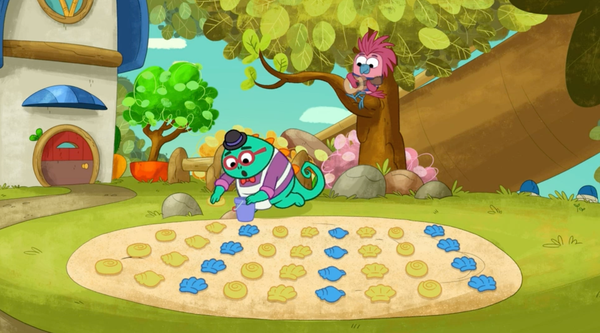
Creativity can soar when you practice patterns with blocks. Try organizing the blocks by colors and sizes. Can they create a pattern using both categories? Maybe start with a big blue block, followed by a small blue block, then a big yellow block and a small yellow block. That way, there is a pattern of “big, small, big, small, big small” as well as “blue, blue, yellow, yellow, blue, yellow, yellow, blue, yellow, yellow” Challenge your child by taking some blocks out or messing up the order to see if they can fix it. In the “Zadie’s Shell Shuffle” episode of “Work It Out Wombats!,” Zadie accidentally jumbles up Mr. E’s shell garden. She has to remember the pattern to put it back in the correct order before he gets back.
6.Bake a treat.
Spending time together in the kitchen is a great way to learn and play with patterns. After baking, invite your child to create a pattern with the toppings. What can they make with the different icing colors, fruits, or sprinkles? Encourage your child by reminding them that there are many ways to make patterns, but it’s up to them to choose how to decorate each treat.
7.Look for patterns in nature.
In the “Moon Magic” episode of “Work It Out Wombats!,” Louisa convinces Zeke that she has magical powers because she can predict what shape the moon will be each night. Later on, she shows him her calendar, which outlines the pattern of the moon phases appearing to go from big to small and then back to big. Keep a moon journal to to keep track of the moon’s shape each night and to predict what comes next.
8.Have a dance party.
It’s fun to bust a move! Put together a few favorite dance moves to make a pattern. For example, stomp right, stomp left, then hop! Keep repeating the pattern — stomp, stomp, hop, stomp, stomp, hop. For older kids, match your dance moves with the pattern of the music. See what you can come up with together!